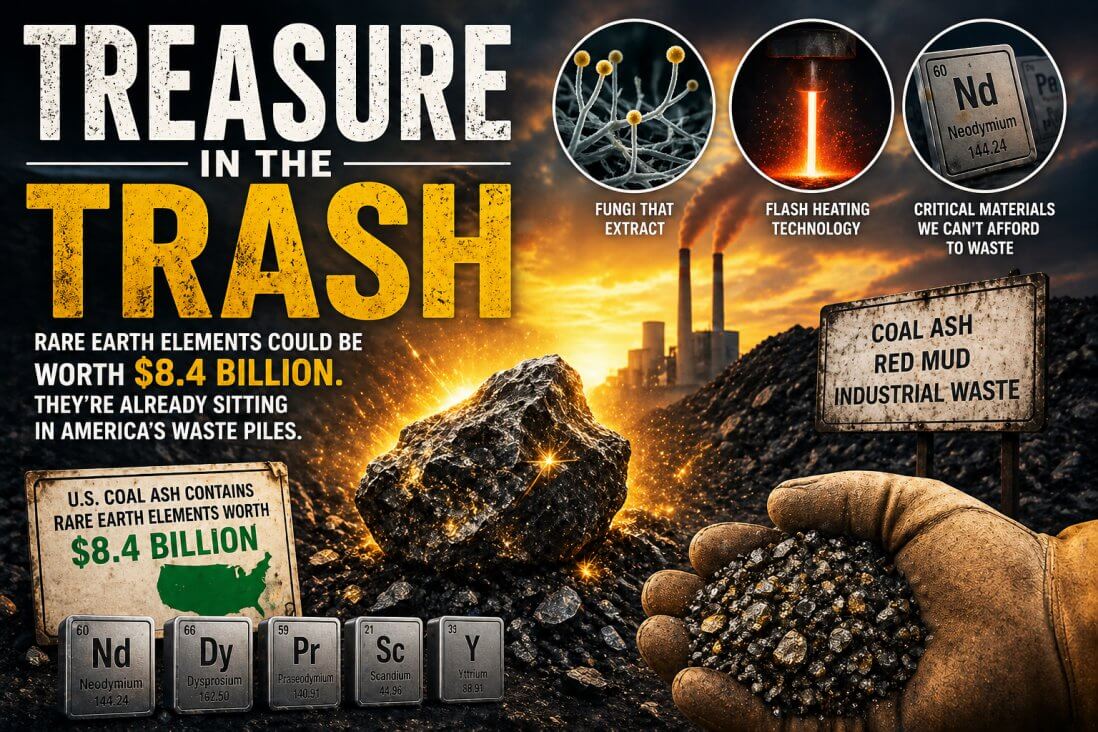
Rare earth metals are hiding in America's waste piles. Here's the wild, weird, and surprisingly exciting story of how scientists plan to dig them out — without digging at all.
Picture this: two scientists in Austria, hunched over petri dishes, watching fungus grow. No explosions. No hardhats. No dramatic mining equipment. Just mold, spreading quietly across a clay dish laced with some of the most strategically valuable materials on the planet.
Welcome to the future of rare earth mining. It smells a little funky — and honestly? It's incredible.
So, What Are Rare Earth Elements, Exactly?
Rare earth elements (REEs) are a group of 17 metallic elements with names like dysprosium, neodymium, and scandium. Say those out loud at your next cookout. Watch the conversation die. Then explain that without these metals, your EV battery doesn't work, your smartphone is a useless glass rectangle, and the clean energy revolution stalls in the driveway.
Here's the twist: despite their dramatic name, rare earths aren't actually rare. They're scattered all over the Earth's crust. The problem is they exist in frustratingly low concentrations, making extraction expensive, chemically intense, and geopolitically messy. About 70% of global REE mining and 90% of processing currently happens in China — which makes a lot of governments very, very nervous.
The Trash Pile Nobody Looked At
Here's what makes scientists smirk while diplomats argue over maps: enormous quantities of rare earth elements are already sitting right here in the United States. Not buried deep underground. Not locked in another country's territory.
In landfills. In coal ash piles. In the red sludge left over from making aluminum.
When coal gets burned for electricity, rare earth elements don't combust — they stay behind, concentrating themselves in the leftover ash. Hydrogeologist Bridget Scanlon at the University of Texas at Austin and her team crunched the numbers on this, and the result is staggering. US coal ash piles alone could hold rare earths worth an estimated $8.4 billion. Just sitting there, in grey heaps, next to old power plants.
Then there's "red mud” -the rusty waste sludge produced when bauxite is refined into aluminum. Around 30 million tons of it exist in the US, with rare earth concentrations running at roughly 10 to 20 times the levels found naturally in the Earth's crust. We've been carefully hauling this stuff away and piling it in containment areas, completely unaware we were essentially gift-wrapping a critical mineral stockpile and leaving it in the yard.
Fungi, Flash Heating, and Some Very Creative Science
At the University of Vienna, researchers Alexander Bismarck and Mitchell Jones are pioneering a concept they call "mycomining" — using fungal networks to absorb rare earth elements directly from contaminated soil, harvesting the biomass, and separating the REEs from the resulting ash. Fungi grow fast, survive in the dark, spread across vast areas, and can be collected using standard agricultural equipment. Nature's own extraction crew, essentially working for free.
Meanwhile at Rice University, professor James Tour's team has developed flash joule heating — blasting waste material with intense electrical current, causing target rare earth elements to bond with a chlorine compound and escape as capturable vapor. The equipment is portable enough to mount on trucks and drive directly to a waste site. It works on coal ash, red mud, and old waste magnets. Less energy than traditional mining. No ocean-crossing shipping required.
Neither approach is fully commercial yet — but both are advancing fast, and investment is accelerating across the board.
Where Soil Screening Fits Into All of This
Every one of these recovery processes — regardless of how sophisticated the downstream chemistry or biology gets — starts with the same unglamorous but absolutely essential first step: physical material separation.
Before fungi can do their work, before flash heating can zap anything useful, before acid leaching and solvent extraction can isolate individual elements, someone has to classify the raw material. Sort particle sizes. Remove oversized debris. Prepare a consistent, workable feedstock from what is, let's be honest, a massive pile of industrial waste.
That's a soil screening job. And the equipment you use matters enormously at that scale.
Here's where the real money conversation starts. Too many contractors and site operators are still loading mixed material onto trucks, paying hauling fees, waiting in line at the landfill, and writing checks for tipping fees — all to get rid of material that has usable value sitting right inside it. Every load you haul away unscreened is profit you're literally trucking off your own jobsite. Stop paying to haul topsoil, screen it on-site, and keep your profits. A quality topsoil screener or portable screener for recycling doesn't just process material faster — it turns a cost center into a revenue stream, often paying for itself in a single season.
Ready to Screen Your Way Into the Future?
Whether you need a small rock screen for a tight residential site, a rock dirt separator for a large-scale remediation project, or a heavy-duty loader screener that keeps pace with your equipment, the right machine changes the math on every job. Operators using a soil sifter machine on-site are reclaiming sellable topsoil, clean aggregate, and screened fill that would otherwise leave the property at their expense. And for contractors working on landscape or hardscape jobs, a landscape rock cleaning machine means reclaimed stone and gravel that goes straight back into the project — or straight to the yard to sell.
At EZ-Screen, we manufacture tough, efficient, portable soil screeners right here in the USA — built for exactly these kinds of heavy-duty separation jobs and designed to help operators process more material, recover more value, and put more money back in their pocket on every single job. If the next wave of material recovery is going to come from America's waste piles and jobsites, it's going to start with a screener. Make sure you've got the right one.





Leave a Reply