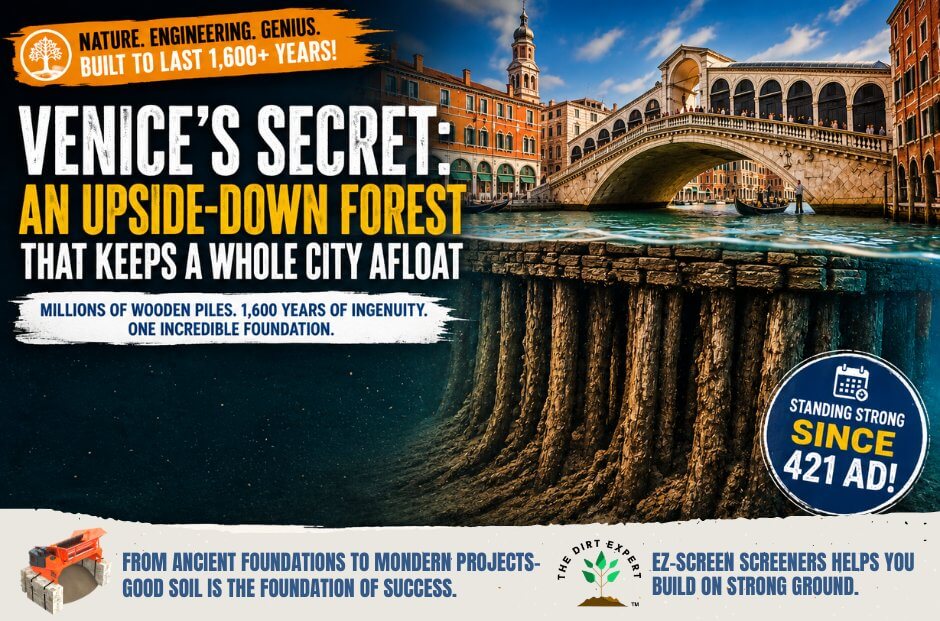
Ever wondered what keeps Venice from becoming the world's most elaborate swimming pool? Turns out, it's standing on millions of wooden stilts like an architectural circus act that's been running for over 1,600 years! While most modern buildings are designed with a "meh, 50 years ought to do it" attitude, Venice has been rocking its wooden foundation game since 421 AD. Talk about overachieving!
The Ultimate Tree Recycling Program
Picture this: Venice is basically an upside-down forest. No, seriously! The entire city is perched atop millions of wooden piles driven tip-down into the lagoon's muddy bottom. These aren't just any trees – we're talking a whole botanical garden of larch, oak, alder, pine, spruce, and elm, ranging from just under 3 feet to almost 12 feet long.
While today's engineers use fancy reinforced concrete and steel (with warranties that basically say "good luck after 50 years!"), these medieval builders were playing 4D chess with Mother Nature. The Rialto Bridge alone is supported by 14,000 wooden poles packed tighter than sardines in a can. And San Marco Basilica? That baby's sitting on 10,000 oak trees that have been holding up the place since 832 AD. Talk about putting down roots!
The Original "Pile Drivers" Had Their Own Playlist
The folks who hammered these piles into the mud were called "battipali" (literally "pile hitters"), and they even had their own work songs! Think sea shanties, but muddier. These tunes praised Venice, dissed their enemies (especially those pesky Turks), and kept everyone hammering in rhythm.
Even today, Venetians still use the expression "na testa da bater pai" (a head good for pounding piles) as a colorful way of calling someone a blockhead. Seems their ancient foundation techniques were matched only by their world-class insult game!
An Engineering Marvel That Would Make Modern Builders Cry
The installation technique was nothing short of genius. Workers drove these piles as deep as they could go, starting from the outside and spiraling inward, fitting about nine piles into every square meter. Once they were all in place, the tops were sawn off to create a level surface below sea level.
On top of this wooden platform went transverse structures – either boards (zatteroni) or beams (madieri) – up to 20 inches thick for bell towers and 8 inches or less for other buildings. This created a solid foundation for the stone structures above. No computer modeling, no fancy equipment – just pure ingenuity and a lot of elbow grease.
Tree Huggers Before It Was Cool
The Republic of Venice was into sustainable forestry before it was trendy. They invented sylviculture (fancy word for tree farming) and created the first official forestry document in Italy back in 1111 AD. Meanwhile, countries like England were chopping down trees like there was no tomorrow and facing wood shortages by the mid-1500s.
Not Just Any Pile of Sticks
Venice isn't the only city built on wooden piles – Amsterdam got in on the action too – but Venice's technique is unique. Most pile foundations work like table legs, extending all the way to bedrock. But Venice's genius was using shorter piles that rely on friction and hydrostatic pressure instead.
By packing the piles closely together, they created a system where the soil "grips" the wood. As Professor Thomas Leslie puts it, they're "using the fluid nature of the soil to provide resistance." It's like thousands of tiny soil hands holding onto these wooden poles for dear life – and doing a pretty good job of it for over 1,600 years!
How's It Holding Up? Pretty Darn Well!
After one-and-a-half millennia underwater, Venice's foundations have proven remarkably resilient, though not without some issues. The Frari Church bell tower, built in 1440 on alder piles, has been sinking about 1mm per year – totaling about 24 inches over its lifetime. Bell towers, with their concentrated weight, sink faster than other buildings, "like a stiletto heel" according to one researcher. (Ladies, you know what they're talking about!)
The Three Musketeers of Stability: Wood, Water, and Mud
The foundation's longevity depends on this perfect trifecta – wood provides friction, soil creates an oxygen-free environment, and water maintains the cellular structure. Remove any one element, and the whole system collapses faster than a sandcastle at high tide.
For centuries, builders completely abandoned wood for cement foundations. But recently, wood is making a comeback in construction (hello, wooden skyscrapers!). It's carbon-friendly, biodegradable, and surprisingly earthquake-resistant.
Ready to Become a Modern Soil Master?
While we can't help you build the next Venice (sorry!), our EZ-Screen portable soil screeners and dirt screeners can help you make the most of your dirt, compost, and aggregate materials with efficiency that would make those medieval engineers jealous.
REQUEST A QUOTE and join the ranks of soil management experts who know that proper soil screening is the foundation of any successful project – just like those wooden piles under Venice!
After all, if those medieval Venetians could build a floating city with just wood, water, and mud, imagine what you could accomplish with an EZ-Screen topsoil screener on your side!





Leave a Reply